

Vinyl vs Spotify: Why Are People Still Buying Records in the Streaming Era?

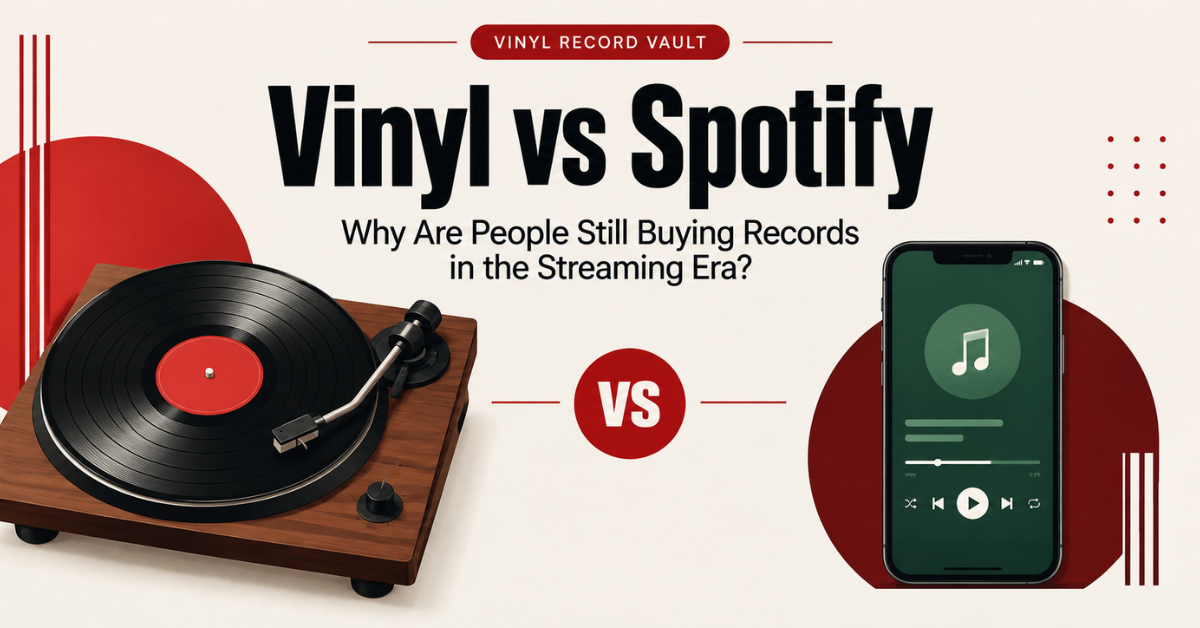
You can carry millions of songs in your pocket today.
With Spotify and other streaming platforms, listeners can play almost any artist, album or playlist within seconds. There is no need to visit a music store, buy a physical copy or find somewhere to store hundreds of albums.
So why are people still buying vinyl records?
Vinyl has made a strong return among music fans, collectors and younger listeners who grew up in the streaming era. For some, it is about sound. For others, it is about collecting, album artwork, nostalgia or simply enjoying music in a more intentional way.
The truth is that vinyl and Spotify offer very different listening experiences. One gives you instant access and convenience; the other gives you something physical to own.
Let’s look at why both formats continue to have a place in modern music.
Vinyl vs Spotify: What’s the Difference?
The most obvious difference is how you access the music.
Spotify is a digital streaming service. You can search for an artist, choose an album and start listening almost immediately. Your music library can contain thousands of albums without taking up physical space.
Vinyl records are physical releases. You purchase an album, own the record and use a turntable and audio equipment to play it.
This creates a completely different relationship with music.
With Spotify, the focus is on access.
With vinyl, the focus is often on ownership and experience.
Neither approach is automatically better. They simply serve different purposes.
Why Do People Still Buy Vinyl Records?
1. Vinyl Makes Music Feel More Physical
Streaming is incredibly convenient, but it can also make music feel temporary.
You select an album, listen to it and move on to another one.
A vinyl record gives you something tangible.
You can hold the album, look through the artwork, read the sleeve notes and physically place the record on your turntable.
For many collectors, this physical interaction is part of what makes vinyl enjoyable.
The album becomes more than a collection of audio files. It becomes an object connected to a particular artist, album or period of their life.
2. Album Artwork Becomes Part of the Experience
Album artwork is easy to overlook when you’re listening through a phone.
On vinyl, artwork becomes much more prominent.
The large record sleeve gives artists and designers considerably more physical space to present an album’s visual identity.
Classic covers from artists such as Pink Floyd, The Beatles, Michael Jackson and countless others have become recognisable pieces of music culture.
For collectors, the cover can be almost as important as the record itself.
This is one reason vinyl records can also become part of a room’s décor or a personal collection.
3. Vinyl Encourages Intentional Listening
One of the biggest differences between streaming and vinyl is the listening process.
On Spotify, it is easy to skip a song.
You can create a playlist, shuffle an album or jump between artists within seconds.
Vinyl encourages a different habit.
You choose a record, take it out of its sleeve, place it on the turntable and start playing.
You may listen to an entire side before turning the record over.
For some listeners, this creates a more focused experience.
Instead of constantly searching for the next song, they spend time with one album.
4. People Like Owning Their Favourite Albums
Streaming gives you access to music, but buying vinyl gives you ownership of a physical release.
That difference matters to collectors.
Someone may have hundreds of favourite albums saved on Spotify but only a small number of records at home.
Those physical records are usually albums that mean something to them.
It could be the first album they bought, a record from their favourite artist, an important album from their teenage years or a special edition they wanted to own.
The collection becomes a reflection of personal taste.
5. Vinyl Has a Unique Listening Experience
Vinyl has a different playback process from digital streaming.
The record’s grooves contain the analogue audio information, which is read by the turntable’s stylus and converted into an electrical signal.
However, it is important not to assume that every vinyl pressing will automatically sound better than its digital version.
Sound quality depends on several factors, including:
- The original recording
- Mastering
- The pressing
- Condition of the record
- Turntable
- Cartridge and stylus
- Amplifier
- Speakers
- Listening environment
A well-mastered digital recording can sound excellent, while a poorly produced vinyl pressing may not.
For many vinyl fans, therefore, the appeal is not simply about claiming that analogue is always superior.
It is about the overall listening experience.
6. Vinyl Has Collecting Value
Streaming libraries are mostly digital and intangible.
A vinyl collection is physical.
Collectors can search for particular pressings, editions, colours, releases and records from different periods.
Some records are widely available, while others may be harder to find.
The condition of the record and sleeve can also affect its desirability among collectors.
However, it is important to distinguish between collecting and investing.
Not every vinyl record becomes valuable. Popularity, rarity, condition, pressing details and demand can all influence the value of a record.
Buying vinyl simply because you expect its price to increase is very different from collecting music that you genuinely enjoy.
7. Vinyl Can Bring Back Nostalgia
For older listeners, vinyl may remind them of how they listened to music before streaming existed.
For younger listeners, the appeal can be completely different.
Someone who grew up with Spotify may find the physical format new and interesting.
This is one reason vinyl has crossed generations.
Parents may return to records they owned years ago, while younger listeners discover vinyl for the first time through artists they already listen to digitally.
8. Spotify Is Still Extremely Convenient
While vinyl has plenty of advantages, streaming has completely changed how people access music.
Spotify allows listeners to:
- Search for millions of songs
- Create playlists
- Discover new artists
- Listen on smartphones
- Access music while travelling
- Share playlists
- Listen without owning physical equipment
- Explore music at relatively low cost compared with building a large physical collection
For discovering new music, streaming is incredibly useful.
You might hear an artist on a playlist today and decide to buy their vinyl record next month.
In that sense, Spotify and vinyl don’t necessarily compete.
They can actually complement each other.
Vinyl vs Spotify: Which One Should You Choose?
There is no single answer.
It depends on what you want from music.
| Vinyl | Spotify |
| Physical ownership | Digital access |
| Collectable | Convenient |
| Large album artwork | Instant playback |
| Requires a turntable setup | Works on phones and computers |
| Encourages album listening | Easy playlists and discovery |
| Takes physical space | Requires almost no physical storage |
| Can become a collection | Huge digital library |
| Tangible listening experience | Highly portable |
If your priority is convenience, discovery and portability, streaming makes sense.
If you enjoy collecting, physical albums, artwork and the ritual of listening, vinyl offers something very different.
Many music lovers simply use both.
They discover an artist through Spotify and later buy their favourite album on vinyl.
Why Vinyl Makes Sense in the Streaming Era
The return of vinyl isn’t necessarily about people abandoning digital music.
It is about people wanting something that streaming cannot provide: a physical connection to an album.
A record can sit on a shelf. You can hold it, examine the artwork, read the details on the sleeve and play it on a turntable.
For some listeners, that experience makes them slow down and pay more attention to the album.
Streaming is designed around access.
Vinyl is designed around ownership.
And there is room for both.
Final Thoughts
Spotify has made discovering and listening to music easier than ever. You can access an enormous catalogue without owning a single physical album.
Yet vinyl continues to attract listeners because music is not always about convenience.
For collectors and enthusiasts, buying a record can be about the artwork, the physical format, the listening ritual, nostalgia or simply owning an album they love.
The best part is that you don’t necessarily have to choose one.
Use Spotify to discover new music, build playlists and explore artists. Buy vinyl when an album becomes special enough that you want something physical to keep.
In the streaming era, perhaps the real appeal of vinyl is simple:
You don’t just listen to the album. You own a piece of the experience.
Frequently Asked Questions
1. Is vinyl better than Spotify?
Neither format is automatically better. Spotify offers convenience, portability and access to a huge music catalogue, while vinyl offers a physical and more traditional album-listening experience. Sound quality depends on factors such as mastering, pressing quality and playback equipment.
2. Why are people buying vinyl records when music is available on Spotify?
People buy vinyl for different reasons, including collecting, physical ownership, album artwork, nostalgia and the experience of listening to a complete album. For many listeners, vinyl provides something that digital streaming cannot: a physical connection to their music.
3. Is vinyl more expensive than Spotify?
Generally, building a vinyl collection costs more than using a streaming service because you purchase individual physical records and need compatible playback equipment. However, the two formats offer different experiences, so the comparison is not simply about price.
4. Can I use Spotify and vinyl together?
Yes. Many music fans use both. Spotify can be useful for discovering artists, exploring albums and creating playlists, while vinyl can be used to own and enjoy favourite albums physically.
5. Are vinyl records a good investment?
Vinyl should not automatically be considered an investment. Some rare or sought-after records can become valuable, but many records do not increase significantly in price. Factors such as rarity, pressing, condition, demand and edition can influence collectability and value. It is generally better to buy records because you enjoy the music rather than expecting them to appreciate.
 Dispatch in 7 Days
 Metal
Metal Rock
Rock Folk Rock
 Country
 Indie
Indie Acoustic
 Jazz
Jazz Classical
 POP
POP Hip Hop
 Rap
Rap Electronic
 R&B
R&B Reggae